No Reagents for the In Silico Phase
Confidence-Scored Results
Publication-Ready Figures
Validation Planned With Partners
Response Within One Business Day
Core Capabilities
1
Fitness Landscape Mapping
Evaluate millions of substitutions in silico — identify hot-spots and epistatic pairs before any bench work.
2
Structure-Guided Design
A structural model guides every mutation choice — active site geometry, substrate pose and local flexibility are all modelled, with confidence reported per region.
3
Thermostability Engineering
Predicted folding free energy changes identify stabilising mutations, scored by several independent routes so that mutations supported by all of them can be prioritised.
4
Substrate Scope Expansion
Docking-guided pocket remodelling broadens or redirects substrate specificity without sacrificing activity.
5
Expression Optimisation
Aggregation & signal-peptide models filter candidates for soluble E. coli / Pichia expression.
6
HTS Validation
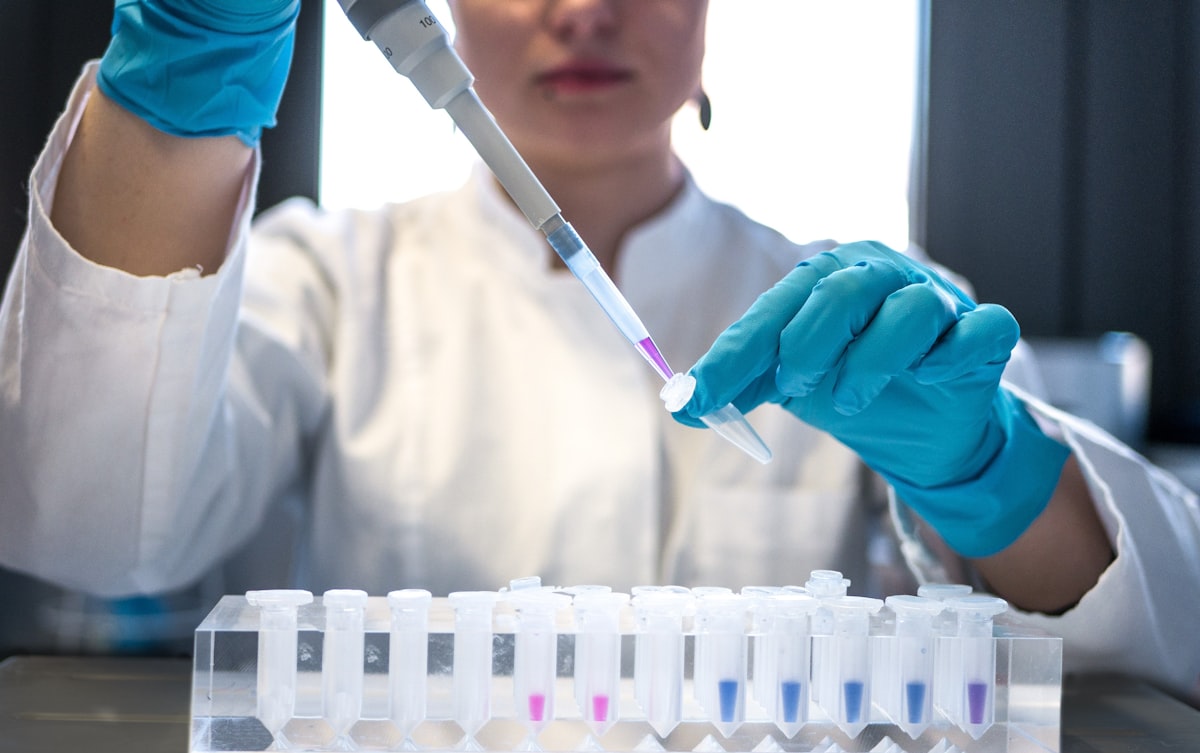
Top 200–500 AI-ranked variants expressed and screened in 96/384-well format with automated liquid handling.
In the Lab and In Silico
How an engineering campaign runs
Computation selects which variants are worth making; the laboratory supplies the measurements that make the next round better.

Application Areas
Lipases & Proteases
Enhanced activity at extreme pH / temperature for detergent and food-processing applications.
Oxidoreductases
P450s, laccases, peroxidases — broadened substrate scope for organic synthesis and green chemistry.
Transaminases & Ketoreductases
Stereospecificity engineering for chiral intermediates in pharmaceutical manufacturing.
Glycosyltransferases
Regioselectivity and donor specificity engineering for complex glycoconjugate synthesis.
In the Lab and In Silico
How an engineering campaign runs
Computation selects which variants are worth making; the laboratory supplies the measurements that make the next round better.
Engineering Workflow
1
Target Definition
Provide the sequence and current activity data. We build a structural model with per-region confidence and define the engineering objectives with you.
›
2
Fitness Landscape
Model-based scanning across single and combinatorial mutations — millions of variants scored, each with a fitness estimate and a predicted stability change.
›
3
Library Design
Top 200–500 predicted variants selected; synthetic gene library ordered (oligo pool or site-directed).
4
HTS Screening
E. coli or Pichia expression in 96-well plate; automated activity assay (fluorometric / colorimetric).
›
5
Hit Characterisation
Km, kcat, kcat/Km, and Tm measured for top hits. Second AI iteration launched if needed.
›
6
Delivery & Report
Final optimised sequence + comprehensive report: fitness heatmaps, kinetics, thermostability curves.
In the Lab and In Silico
How an engineering campaign runs
Computation selects which variants are worth making; the laboratory supplies the measurements that make the next round better.
What We Compute
Fitness prediction
Score per variant, with held-out validation
Structure & active site
Model with per-region confidence
Sequence design
Ranked substitutions per position
Stability change
Predicted ΔΔG per mutation
Library composition
Diversity, coverage, screening effort
Substrate docking
Poses, tunnels and access analysis
In the Lab and In Silico
How an engineering campaign runs
Computation selects which variants are worth making; the laboratory supplies the measurements that make the next round better.
Service Modules & Turnaround
In the Lab and In Silico
How an engineering campaign runs
Computation selects which variants are worth making; the laboratory supplies the measurements that make the next round better.
Is This the Right Service for You?
Choose this when
Enzyme activity, selectivity or stability must improve beyond random mutagenesis
Screening capacity is the constraint and libraries must be small
Measured variant data can be returned to retrain models between rounds
Consider another service when
Only thermal stability is the limiting property
Protein Stability & Thermostability Engineering A new protein must be built rather than an existing one improved
De Novo Protein Design What Goes Wrong, and How We Handle It
These are the failure modes that produce confident-looking results which do not survive the next experiment. Each one is designed against rather than discovered afterwards.
Activity predictions trusted like stability predictions
Activity prediction is less accurate; computation shrinks libraries rather than replacing screening, and the distinction is stated.
Libraries larger than the assay can screen
Library size is derived from your measured throughput so the designed diversity is actually sampled.
Rounds that do not learn from each other
Measured data retrains the models between rounds, which is where most of the campaign gain comes from.
A Worked Example
Three rounds against a non-natural substrate
The situation
The wild-type enzyme accepted the non-natural substrate poorly and prior mutagenesis had stalled.
What the work involved
Active site and access tunnels were modelled with the substrate, positions were prioritised from structure and coevolution, and a focused library was designed to the size the team could screen completely.
What came back
A library an order of magnitude smaller than the previous random one, with round-one data retraining the model for round two and a defined data requirement for each subsequent round.
Illustrative of the shape this work takes. Details are generalised, no client or target is identified, and scope and outcome vary with the system in question.
What Published Work Reports
The results below were published by independent groups and are cited to show what these computational approaches have achieved in the literature. They are not ICDMO project results, and outcomes vary substantially between targets, datasets and programmes. We do not promise comparable results for any particular project.
Machine-learning-guided evolution raised a reaction yield from 12% to 93%
An active-learning workflow optimising five interacting active-site residues improved the yield of a desired non-native cyclopropanation product from 12% to 93% in three rounds of laboratory experimentation. The design principle is the one we apply: computation chooses which small set of variants to make, and measured results retrain the model between rounds.
Nature Communications, 2025 ↗1.6- to 42-fold activity improvements from model-selected enzyme variants
A machine-learning-guided enzyme engineering campaign evaluated 1,217 variants across 10,953 reactions to build predictive models for amide synthetases. Model-selected variants showed 1.6- to 42-fold improved activity relative to the parent enzyme across nine pharmaceutical targets, illustrating both the scale of data that makes models predictive and the spread of outcomes that remains.
Nature Communications, 2024 ↗De novo binder design succeeds at rates that vary enormously by target
Recent design methods report nanomolar binder hit rates between roughly 17% and 82% across evaluated targets, while independent evaluations of earlier pipelines on other targets report designs failing on expression, non-specific binding or undetectable affinity. The honest reading is that de novo binder design now works, that success is strongly target-dependent, and that panels must be sized accordingly rather than on a best-case figure.
Comparative design studies, bioRxiv, 2025 ↗What We Need From You
▸Enzyme sequence and structure, with the reaction, substrate and product clearly specified
▸Any existing variant data, however small, since even modest datasets improve the models substantially
▸The improvement target: activity, selectivity, stability, substrate scope or process tolerance
▸Process conditions the enzyme must survive: temperature, pH, solvent, substrate loading
▸Screening throughput available, which determines whether we design discrete variants or a focused library
How the Analysis Is Performed
▸Active site and mechanism analysis covering substrate binding, catalytic residues and access tunnels
▸Substrate and transition state modelling, including docking and QM/MM treatment where the mechanism warrants it
▸Position selection combining structural proximity, evolutionary coupling and predicted mutational tolerance
▸Fitness landscape modelling with protein language models and supervised learning on available variant data
▸Stability prediction alongside activity, since activity-improving mutations are frequently destabilising
▸Focused library design with codon and diversity specification matched to your screening capacity
What You Receive
▸Prioritised position list with the structural and evolutionary reasoning behind each selection
▸Designed variant sets, or focused library specifications with codon schemes ready for construction
▸Structural models of the leading designs with substrate and transition state analysis
▸Predicted activity and stability effects per variant, with the trade-off between them made explicit
▸A round-based campaign plan stating what data is needed to retrain the models for the next round
Interpretation and Limitations
Activity prediction remains considerably less accurate than stability prediction, which is why computation is used to shrink libraries rather than to replace screening. Improvements are enzyme-specific and cannot be promised in advance; some campaigns plateau. Model quality depends heavily on the quantity and consistency of measured variant data returned between rounds, and all deliverables are for research use only.
Questions We Are Asked Before Scoping
How much variant data do we need to start?
None, since structure and evolutionary information support a first round. A few dozen measured variants improve the models noticeably, and several hundred allow genuinely predictive modelling.
Can computation replace directed evolution?
No, and it should not try. It reduces library size and raises hit density, which shortens campaigns. Screening remains essential because activity prediction is still imprecise.
What improvement is realistic?
Order-of-magnitude gains in activity or selectivity are achievable across a multi-round campaign for many systems, but outcomes vary by enzyme and no responsible provider can commit to a figure up front.
Get a Custom Quote
Our AI scientists reply within 24 h with a technical proposal and fixed-price quote.
Contact Us Online ConsultationStandard Deliverables
✓Fitness landscape heatmap (PDF + CSV)
✓Optimised variant sequence (FASTA)
✓Kinetics & thermostability data
✓Publication-ready figures
✓Full project report
Why ICDMO AI?
Computational CDMO Focus
Reproducible, Versioned Pipelines
Validation Planned With Partners
Response Within One Business Day